
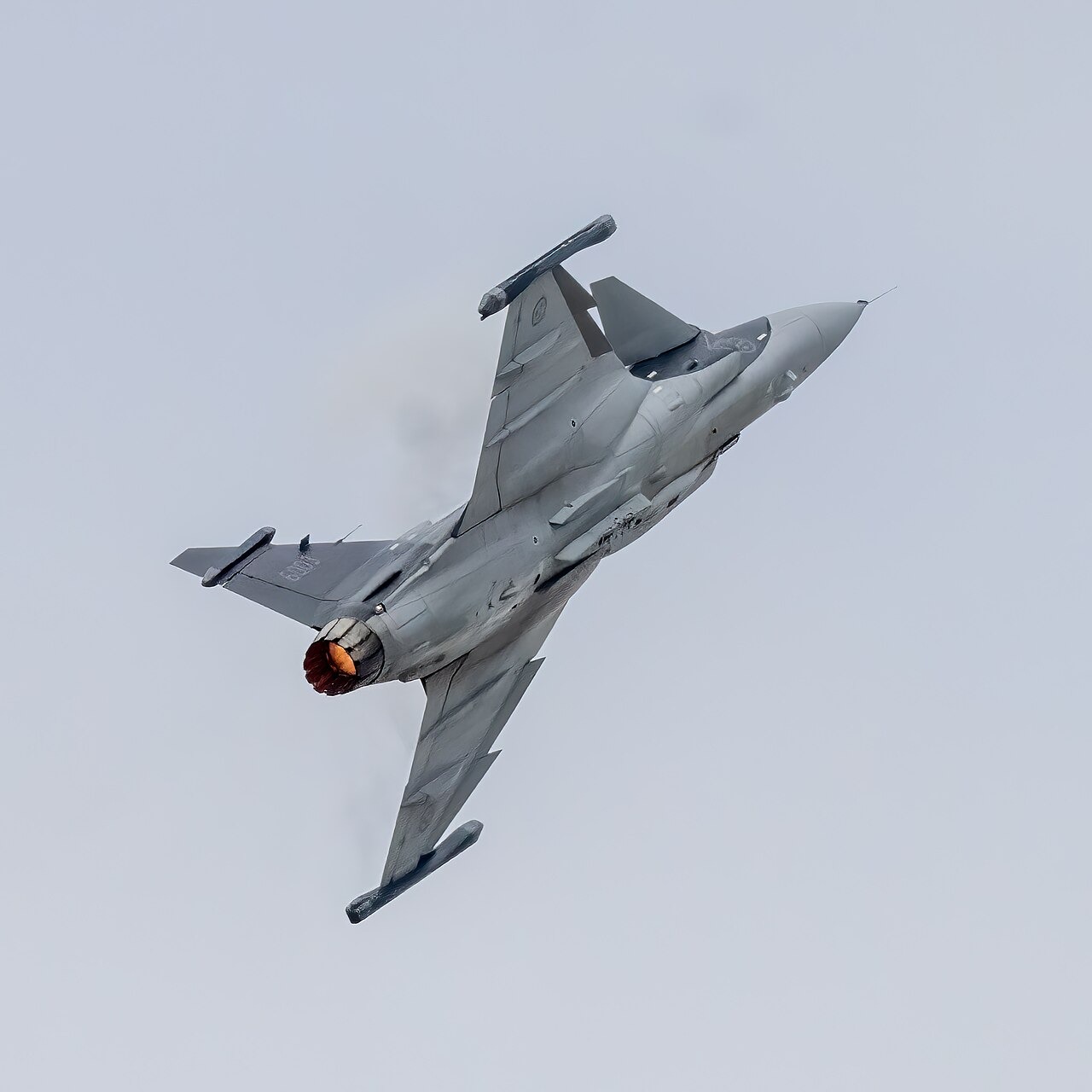
Saab has unveiled an in-house family of artificial-intelligence agents for future aircraft after testing the technology with a Gripen E fighter, according to Breaking Defense. The company says the agents are designed to make tactical decisions in complex operational environments and could work with a pilot in a cockpit or aboard an uncrewed aircraft.
The new AI Fighter Pilot Academy is intended to provide a repeatable development and evaluation process. Saab says it will create, train and assess agents using operational scenarios, high-fidelity simulations and subsequent aircraft testing. EDR Magazine reports that Saab’s process is organized around defined operational needs, large-scale training, testing under degraded conditions and evidence-building before flight trials. Saab’s head of Advanced Programs, Peter Nilsson, said flight validation would remain essential. EDR’s report also says the Gripen testing so far involved bounded tactical autonomy in a defined beyond-visual-range scenario.
The scale of the training environment is a central part of the announcement. Nilsson told Breaking Defense that a one-hour simulated training flight using the Sferical AI computing initiative could produce the equivalent of one billion flight hours for a human pilot, although the sources do not provide a performance validation method for that comparison. EDR reports that Sferical One is a sovereign NVIDIA DGX SuperPOD-based system built from 16 NVIDIA DGX GB300 systems and began operating in summer 2026.
The evidence therefore points to an industrial training and assurance capability, not a fielded autonomous fighter. EDR quotes Nilsson describing the next stages as expanding from bounded tactical actions toward team coordination and mission-level functions, while explicitly characterizing the effort as capability development rather than a deployment timetable. Saab’s immediate documented milestone is the creation of the academy and its supporting compute and evaluation infrastructure.