
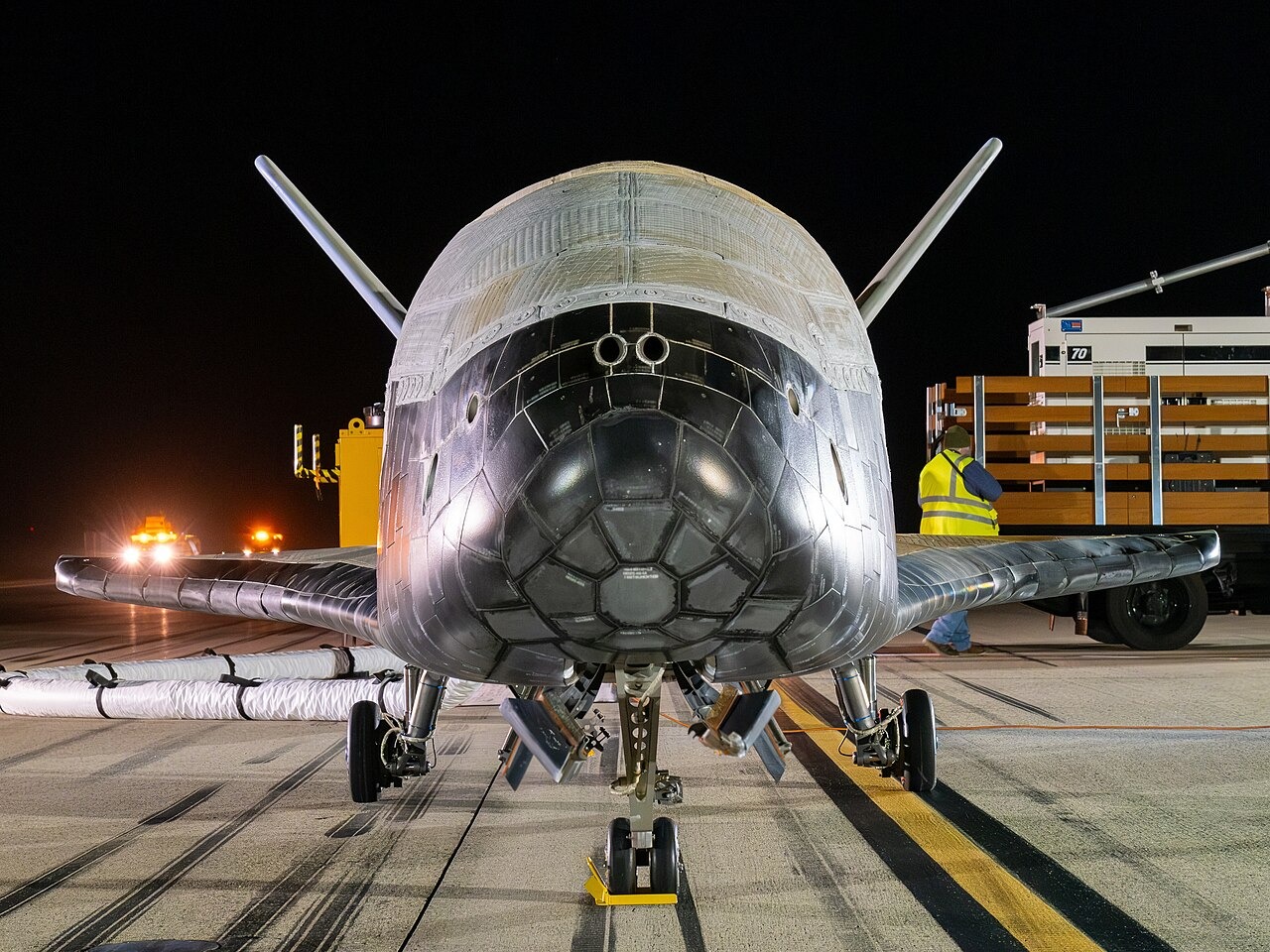
The War Zone’s newly published technical analysis examines a higher-resolution orbital image that the Defense Intelligence Agency identifies as an experimental Chinese reusable spaceplane. The fresh finding is the analysis of the vehicle’s visible configuration and its comparison with the U.S. Space Force’s X-37B—not the basic existence of the photograph, which The War Zone reports was already shown in lower resolution in a 2024 presentation. The War Zone’s analysis dates the new technical assessment to October 27.
The image shows a shuttle-like vehicle with small wings, twin vertical tails, an apparent upward-opening payload bay and solar panels deployed near the tail. The War Zone says the design is highly similar to the X-37B, while noting that the Chinese vehicle appears to have wings with a longer chord. The report does not establish the image’s exact capture time; it carries a 2024 copyright date. DIA’s caption, as reported by The War Zone, says spaceplanes can place objects in orbit, test them and return to Earth.
The underlying DIA disclosure places the image within a broader assessment of China’s space capabilities. Breaking Defense reports that the agency’s unclassified Challenges to Space Security report says China had more than 510 ISR satellites in orbit as of July, counting satellites owned by both the Chinese government and commercial firms. Breaking Defense’s report says the DIA assessment describes those systems as supporting worldwide monitoring and potential targeting of U.S. and allied forces.
The vehicle has a documented test history, but not a documented operational military role. The War Zone reports that China is understood to have conducted four orbital spaceplane missions using the same experimental vehicle since 2020. It also reports that the vehicle released smaller objects during an earlier mission, although their purpose remains unknown. Those observations support recurring experimentation; they do not by themselves demonstrate deployment for military operations.
The satellite figures also require caution. Breaking Defense attributes comparison data to AEI’s Todd Harrison, who said China’s operational surveillance and weather satellite fleet grew from 141 in 2018 to 541, while its surveillance-only fleet rose from 124 to 453. He also said the DIA data does not clearly explain which satellites are included and that growth has slowed in recent years. The combined evidence therefore shows an expanding sensing and spaceplane-development effort, while leaving the vehicle’s payloads, missions and operational status unresolved.